This was a “we tried everything, nothing works for us” kind of client. Almost all their sales were coming to them through word-of-mouth or by chance.
We were looking for new ways to build up their customer base. They really tried a lot of marketing things but in a very chaotic manner.
This client hired me and I was asked to bring in and implement a marketing strategy in order to achieve 5X growth by the end of the year.
To deal with this task, I decided against my regular “Search ads -> Retargeting -> FB ads” marketing launch sequence. I dug up the “Bullseye Framework for Getting Traction” article from amongst my saved items and made it my starting point. However, I started making adjustments to the framework, and it turned into a new comprehensive, actionable methodology that brought value for this business.
So let’s jump to the concrete steps we took with my client’s marketing team to achieve their goal. I named it “The Acquisition Ax” framework.
Ideas Brainstorm
I created a list called “Brainstorm” in Trello.
I put 22 different channels and sources as separate Trello cards into this column. I modified the original list from the “bullseye” article based on my experience and professional focus. Nevertheless, I decided to keep non-standard channels here. I found them highly useful for amplifying creativity and bringing some fun to brainstorm sessions.

We started brainstorming ideas for every card. The purpose was to come up with 1–3 tactics we could use to get clients from this channel or traffic source.
The ground rule was that criticism or any “it will not work because…” comments were prohibited. Even the most fantastic ideas were welcome.
As the moderator, I tried to manage this session in order to:
- get at least one idea from every teammate for every card;
- limit discussions to 3–6 minutes per card.
Before any discussion of ideas, I gave a brief intro of a channel and an example of other companies’ activities there.
Also, I shared ideas I had prepared before when the team faced difficulties with some channels.
After a couple of hours of productive work, we got a list of different approaches, from really promising to wild ones.
Commitment
Looking at 40+ client acquisition tactics and strategies made me feel like a local marketing king, but it was only the first step.
At the end of our meeting, I asked the guys which ideas they believe in and if they were ready to work on them.
There is no sense in pushing your teammates to take on things they don’t want to own. Otherwise, this project might be entirely or partially sabotaged.
I made duplicates of the guys’ chosen cards and moved them to a new list called “Commitment”.
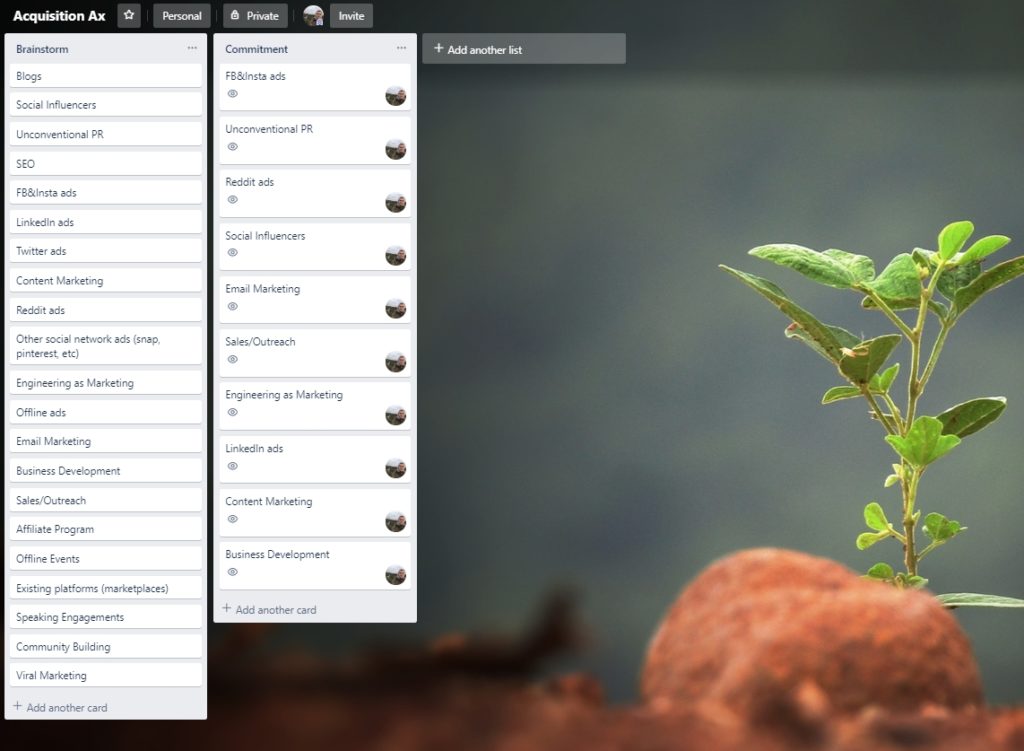
A lifehack: do not talk about the commitment stage before your brainstorm, otherwise it might create some limitations for extracting bold ideas from your team.
Assessment
Now it was time for homework.
At this stage, every channel owner should answer four questions.
1) How many potential customers can we reach there?
Rough estimations based on numbers the tools show or any researches found on Google. In a couple of cases, it was going to take too long to prepare figures, so we agreed to accept “small,” “big,” “huge,” “millions,” “idk” evaluations as well as numeric values.
Typically, here is one answer for a channel, whereas other responses are different for each targeting tactic.
2) Is it possible to execute?
Sometimes we came up with ideas that just couldn’t be delivered because the required targeting options didn’t exist.
So this question can also be explored by reading documentation or asking questions in Facebook groups / on Reddit.
3) Do I believe in the success of this idea?
Do you believe that it can be valuable for your company in a long term perspective?
4) Do we have the resources for this test?
Do you have enough money, people, time, expertise to conduct a minimum viable test to collect any significant results?
Answers like Yes/No/Can’t answer at this stage are good enough for questions 2–4.

Prioritization
During this micro meeting, we copied all cards which contained at least one idea with 3 YES answers to the new list “Choice.”
There was a variant with a tiny potential audience reach. I moved it to the bottom of the list and left a comment on why this channel wasn’t processed further.
Thanks to the creativity of the team, we got more ideas than we could realistically execute in the nearest feature.
So, somehow, we had to prioritize the list and choose customer acquisition channels for this iteration. Hopefully, I remembered the Planning Poker technique.
I asked teammates to vote for channels in terms of how huge a source of clients it might be for us. They were estimating using the Fibonacci sequence from 3 to 13 and laying “cards” (sticks with their rates) face down.
It is a separate story on how to play planning poker. Anyway, if your team uses Jira, I highly recommend trying the Agile Poker for Jira — Planning and Estimation Toolkit.
As a result, we put labels with conferred points on Trello cards and decided that we should split our budget and efforts amongst the four highest-rated sources. Duplicates of these cards were moved to the next list “Choose”.
Choose -> Tested -> Implemented
Starting from this step, we kicked off the real work. Our planning was finished, and we started executing ideas. Instead of endless media planning and presenting slides with “strategic” plans, we got our hands dirty on the 4th day after the first meeting.
I created a separate board to validate our concepts using the HADI-cycles approach. Because our hypotheses were already filtered during the previous meetings, we just went with them through the Hypothesis, Action, Data, Insights steps following the methodology.
To sum up
It was a pretty dynamic process. Based on my experience, an average marketing team needs one weekly sprint for planning and 2–3 bi-weekly sprints in order to get results. Of course, it depends on your traffic volume, resources, and so on. Even more importantly, your expectations and approach to making decisions plays a huge role here. (Previously, we discussed if all decisions should be data-driven.)
I used duplicating cards instead of moving them here to save all the ideas and decisions we had made and be able to review them later.
The entire process can be scheduled as a quarterly/yearly activity for your marketing dept. Then every iteration should have its own Trello board.
P.S. This story never happened. I tried to merge several cases from my previous experience into a single narrative as a means of making it easier to illustrate the framework.
I named it “The Acquisition Ax Framework” because I’d like it to sound cool, and in my imagination, the final board you can see at the top of this page looks like an ax head. Doesn’t it?